Free Diamond Open Access Journals in Agriculture & Allied Sciences: A 2026 Guide for Researchers
Securing a high-visibility platform for academic research often feels like managing a budget rather than focusing purely on scholarly impact. High article processing charges (APCs) can quickly become a barrier for PhD scholars, early-career researchers, and independent academics seeking to share their work with the global scientific community.
When we built our vision at Tholga and launched The Journal Selection Guide series, our primary goal was simple: to make indexed, reputable publishing pathways more transparent and accessible. You should not have to compromise on visibility or stretch your research budget to make your work accessible.
That is where diamond open access models come in. Unlike traditional open access where authors pay an APC or subscription models where readers pay through paywalls, diamond open access journals are completely free for both authors to publish and readers to access.
As part of our journal selection process, we shortlist journals based on the relevant academic discipline rather than selecting journals arbitrarily. For this series, we have focused on journals listed in the Directory of Open Access Journals (DOAJ) that offer free open access to authors and readers.
For the agriculture and allied sciences discipline, we have identified free journals that meet these criteria. Researchers can also search directly on DOAJ to find open access journals that best match their specific research area and requirements.
In this third blog of our weekly series, we present free diamond open access journals in agriculture and allied sciences for 2026.
Open Access Journals Without Payment (Diamond Open Access)
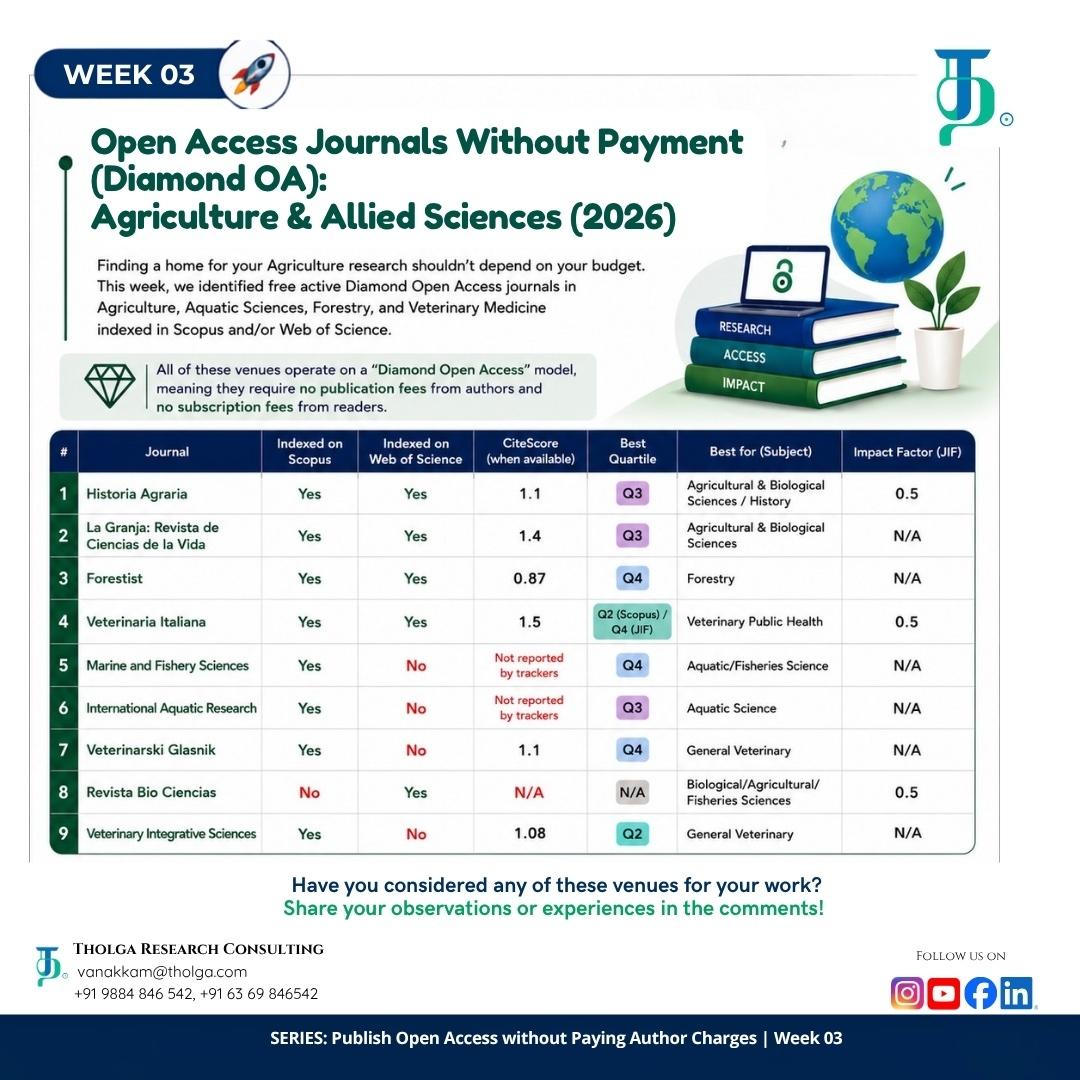
Here is an overview of some indexed diamond open access venues, along with their primary indexing and current performance metrics:
- HistoriaAgraria
- Focus Area: Agricultural history, rural dynamics, and agricultural economics.
- Indexing and Metrics: Indexed in Scopus (Q3) and Web of Science (AHCI/SSCI). Impact Factor: 0.5 (5-yr IF: 0.6) | CiteScore: 1.1.
- La Granja: Revista deCienciasde la Vida
- Focus Area: Agricultural sciences, biological sciences, and environmental research.
- Indexing and Metrics: Indexed in Scopus (Q3) and Web of Science (ESCI). CiteScore: 1.4.
- Forestist
- Focus Area: Forestry management, forest conservation, and wood science.
- Indexing and Metrics: Indexed in Scopus (Q4) and Web of Science (ESCI). CiteScore: ~0.87.
- VeterinariaItaliana
- Focus Area: Veterinary public health, animal epidemiology, and food safety.
- Indexing and Metrics: Indexed in Scopus (Q2) and Web of Science (SCIE). Impact Factor: 0.5 (5-yr IF: 1.0) | CiteScore: 1.5.
- Marine and Fishery Sciences
- Focus Area: Aquatic ecosystems, fisheries management, and marine ecology.
- Indexing and Metrics: Indexed in Scopus (Q4).
- International Aquatic Research
- Focus Area: Aquaculture systems, aquatic biology, and water resource management.
- Indexing and Metrics: Indexed in Scopus (Q3).
- Veterinary Integrative Sciences
- Focus Area: Veterinary medicine, clinical animal care, and comparative pathology.
- Indexing and Metrics: Indexed in Scopus (Q2). CiteScore: 1.08.
- VeterinarskiGlasnik
- Focus Area: General veterinary medicine, animal husbandry, and animal health.
- Indexing and Metrics: Indexed in Scopus (Q4). CiteScore: 1.1.
- Revista BioCiencias
- Focus Area: Biological, agricultural, and fisheries sciences.
- Indexing and Metrics: Indexed in Web of Science (ESCI). Impact Factor: 0.4–0.5.
Understanding the Practical Differences
When determining where to submit your manuscript, evaluating objective scope and indexing databases help match your publication strategy with your career or institutional requirements:
- Dual High-Visibility Coverage: Journals such as Historia Agraria, La Granja, Forestist, and Veterinaria Italiana carry listings across both Scopus and Web of Science core collections, making them suitable for researchers whose institutions require dual database validation.
- Targeted Specialist Outlets: Titles like Marine and Fishery Sciences, International Aquatic Research, Veterinary Integrative Sciences, and Veterinarski Glasnik offer direct Scopus-indexed pathways for focused aquatic, marine, and veterinary research.
- Interdisciplinary Reach: Revista Bio Ciencias provides a platform for broad biological and agricultural studies seeking coverage within the Web of Science Emerging Sources Citation Index (ESCI).
What Scholars Should Check Before Submitting
While diamond open access journals remove financial barriers, rigorous evaluation of target venues remains essential:
- Verify Database Coverage: Indexing statuses can change over time. Double-check the journal’s current listing directly on the official Scopus Master Journal List or Web of Science Master List.
- Review Scope and Guidelines: Ensure your manuscript’s core research questions align with the journal’s active aims and scope to minimize the risk of immediate desk rejection.
- Assess Turnaround Times: Review recently published issues to set realistic expectations regarding peer review timelines and publication schedules.
Conclusion
Finding a reputable, high-visibility journal for your agricultural research does not have to come with heavy financial constraints. By leveraging diamond open access venues, researchers can share their findings globally without facing author processing charges. Whether your focus is on crop sciences, forestry, aquatic biology, or veterinary medicine, taking time to align your manuscript’s scope with the right database indexing ensures your work achieves maximum academic reach.
Disclaimer:
- Tholga is not affiliated with any of these journals, nor does it receive any remuneration from the listed publications. This initiative aims solely to share factual information about indexed diamond open access venues for researchers.
- Authors are advised to verify indexing status, impact metrics, and submission guidelines directly on Scopus, Web of Science, or the official journal homepages before submitting.