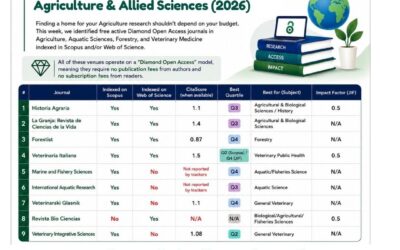

For scholars, getting research published can often feel like navigating a maze of hidden costs rather than showcasing academic rigor. Exorbitant article processing charges (APCs) create a steep obstacle for PhD candidates, early-career academics, and independent authors aiming to publish their findings globally.
At Tholga research consulting, we launched the journal selection guide series to address this exact challenge. Our intent is straightforward: demystify the publication process and spotlight reputable, indexed pathways that do not drain your research budget. High visibility should be achievable without financial strain.
Unlocking fee-free publishing in mathematics & computer science
Diamond Open Access (OA) venues solve this dilemma. Unlike standard open access platforms that demand author APCs, or traditional subscription models that restrict content behind paywalls, Diamond OA journals charge zero publication fees to authors and zero reading fees to the public.
Rather than assembling arbitrary lists, we curate our series by specific disciplinary domains. Every featured journal is evaluated for indexing, metrics, and academic standing to help researchers make informed choices.
For week 04, we focus on free-to-publish, indexed venues across Mathematics & Related Sciences (2026) – spanning computer science logic, big data, applied mathematics, stochastics, and human-computer interaction.
Researchers can also explore platforms like the directory of open access journals (DOAJ) or Scopus to filter venues matching their precise scope, indexing needs, and manuscript parameters.
In this fourth series of our weekly guide, we examine free diamond open access journals in mathematics and related disciplines that researchers should keep on their radar for 2026.
Open access journals without payment (Diamond OA): mathematics & related sciences (2026)
Here is a consolidated overview of selected indexed Diamond OA venues along with their indexing status and key performance metrics:
- Logical Methods in Computer Science
• Focus Area: Theoretical computer science with an emphasis on logical methods, semantics, and foundational computing.
• Indexing and Metrics: Indexed in Scopus and Web of Science. CiteScore: 1.9 | Quartile: Q2 | Impact Factor: 0.6–0.8. - Big Data Mining and Analytics
• Focus Area: Big data architectures, data mining algorithms, artificial intelligence, and advanced analytics.
• Indexing and Metrics: Indexed in Scopus and Web of Science. CiteScore: 12.0 | Quartile: Q1 | Impact Factor: 10.5–13.6. - Journal of Universal Computer Science
• Focus Area: Broad-spectrum computer science, information systems, and applied computing fields.
• Indexing and Metrics: Indexed in Scopus and Web of Science. CiteScore: 2.7 | Quartile: Q3 | Impact Factor: 1.32. - Proceedings of Kazan University: Physics and Mathematics Series
• Focus Area: Interdisciplinary applied mathematics, theoretical physics, and computational modeling.
• Indexing and Metrics: Indexed in Scopus and Web of Science. CiteScore: Not reported by trackers | Quartile: Q3 | Impact Factor: N/A. - Quantum Topology
• Focus Area: Low-dimensional topology, quantum invariants, geometry, and mathematical physics.
• Indexing and Metrics: Indexed in Scopus and Web of Science. CiteScore: Not reported by trackers | Quartile: Q1 | Impact Factor: 0.77–1.0. - Modern Stochastics: Theory and Applications
• Focus Area: Probability theory, mathematical statistics, stochastic processes, and financial mathematics.
• Indexing and Metrics: Indexed in Scopus and Web of Science. CiteScore: Not reported by trackers | Quartile: Q2 | Impact Factor: N/A. - EMS Surveys in Mathematical Sciences
• Focus Area: Comprehensive survey articles across pure and applied mathematics.
• Indexing and Metrics: Indexed in Scopus and Web of Science. CiteScore: 3.2 | Quartile: Q1 | Impact Factor: 1.2. - Journal of Numerical Cognition
• Focus Area: Cognitive processes behind mathematical thinking, numerical processing, and cognitive psychology.
• Indexing and Metrics: Indexed in Scopus (Web of Science: No). CiteScore: 1.0 | Quartile: Q1 | Impact Factor: N/A. - AUT Journal of Mathematics and Computing
• Focus Area: Applied numerical methods, optimization, computational logic, and software metrics.
• Indexing and Metrics: Indexed in Scopus (Web of Science: No). CiteScore: Not reported by trackers | Quartile: Q4 | Impact Factor: N/A. - Journal of Algebra and Related Topics
• Focus Area: Pure algebra, ring theory, module theory, and related algebraic structures.
• Indexing and Metrics: Indexed in Scopus (Web of Science: No). CiteScore: 0.2 | Quartile: Q4 | Impact Factor: N/A. - Информатика и автоматизация (Informatics and Automation)
• Focus Area: Automation systems, informatics, control theory, and computational engineering.
• Indexing and Metrics: Indexed in Scopus (Web of Science: No). CiteScore: 2.1 | Quartile: Q4 | Impact Factor: N/A. - Open Communications in Nonlinear Mathematical Physics
• Focus Area: Nonlinear differential equations, mathematical physics, and integrable systems.
• Indexing and Metrics: Indexed in Scopus (Web of Science: No). CiteScore: Not reported by trackers | Quartile: Q4 | Impact Factor: N/A. - Journal on Interactive Systems
• Focus Area: Human-computer interaction (HCI), user experience engineering, and interactive systems.
• Indexing and Metrics: Indexed in Scopus (Web of Science: No). CiteScore: Not reported by trackers | Quartile: Q3 (Info Systems) | Impact Factor: N/A.
Understanding the practical differences
Selecting an APC-free venue is only the first step. Authors must evaluate scope alignment, indexation status, quartile ranking, and citation trends before submitting a manuscript.
- High-Impact Venues:For maximum reach in data science, Big Data Mining and Analytics offers a Q1 ranking with a high Impact Factor (10.5–13.6). Similarly, EMS Surveys in Mathematical Sciences provides top-tier Q1 placement for broad mathematical reviews.
- Theoretical & Applied Focus: Logical Methods in Computer Science serves authors working on foundational theoretical proofs, while Journal of Universal Computer Science accommodates general computing topics that span multiple technical domains.
- Specialized Fields: Outlets like Quantum Topology and Modern Stochastics cater directly to niche research in pure geometry and statistical theory, respectively.
- Scopus-Only Options:If dual-indexing is not required by your university or funding body, Scopus-indexed outlets like Journal of Numerical Cognition (Q1 in its niche) or Journal on Interactive Systems offer strong alternative avenues for publication.
Selecting the right journal involves matching your paper’s core topic and methodological depth with the target journal’s editorial focus and metrics.
What scholars should check before submitting
- Verify Live Indexing: Database coverage changes over time. Confirm that the venue is currently active on the official Scopus Sources or Web of Science Master Journal List prior to submission.
- Confirm Scope Fit: Re-read the journal’s recent target topics. Even high-quality papers face immediate desktop rejections if the subject matter falls outside the editorial remit.
- Examine Citation & Quartile Metrics: Review metrics like CiteScore and Quartiles together with subject fit to gauge academic reach within your specific domain.
- Inspect Recent Issues: Skim recent articles to confirm that your methodology and manuscript structure align with what the journal actively publishes.
- Check Editorial Timelines: Review published dates on recent papers to estimate peer review and acceptance turnarounds.
Final thoughts
Publishing without APCs does not mean sacrificing academic rigor or audience reach. Diamond Open Access ensures high-quality scientific literature remains available to the global community without imposing financial barriers on researchers.
However, zero submission fees should not be your sole criteria. Always verify indexing, review aims and scope, check editorial guidelines, and plan your submissions strategically.
At Tholga Research Consulting, we guide researchers through journal evaluation, manuscript development, and structured writing habits. Have you submitted to any of these Diamond OA venues? Share your experiences in the comments below or contact our consulting team directly at vanakkam@tholga.com.
Disclaimer
- Tholga is not affiliated with any of these journals, nor does it receive any remuneration from the listed publications. This initiative aims solely to share factual information about indexed Diamond Open Access venues for researchers.
- Authors are advised to verify indexing status, citation metrics, publication policies, and submission guidelines directly through Scopus, Web of Science, DOAJ, or the official journal websites before submitting.